Eight guests, seven nights, the BVI. The itinerary on paper looks identical regardless of hull — Norman to Cooper to The Baths to Anegada to Jost. What changes is the day. The boat is the trip, not the transport, and the choice between a crewed catamaran and a motor yacht reorders almost everything that happens between sunrise coffee and the second nightcap.
We get this question every winter, usually from a group that's done one charter before — often a monohull or a smaller cat — and is now trying to figure out whether to step up into a 60-foot power cat, a 75-foot sailing catamaran, or a proper motor yacht in the 90 to 110 range. The honest answer is that none of them is better. They are different instruments, and the right one depends on how your group actually behaves on the water.
What an eight-guest week actually looks like
The BVI is a forgiving cruising ground. Short hops, line-of-sight navigation, mooring fields in most of the anchorages you'd want, and a customs posture that makes day-to-day movement easy as long as your captain has the paperwork in order. That forgiveness is why the territory works for first-time charterers and why it punishes overbuilt itineraries. You do not need a 110-foot motor yacht to get from Tortola to Virgin Gorda. You need a boat your group is comfortable living on for a week.
For eight guests, the practical envelope is four cabins, four heads, and a crew of two to four depending on hull. Below that and someone is sleeping in a convertible salon berth, which sounds fine in the brochure and feels different on night three. Above that and you are paying for cabins nobody sleeps in.
The day breaks down roughly the same on any platform: breakfast aboard, a morning move of one to three hours, a swim and lunch stop, an afternoon move or a long anchor, then dinner ashore or on board. What differs is how those segments feel. A catamaran spreads the group horizontally — trampolines forward, flybridge above, two hulls of cabins below, a wide aft deck. A motor yacht stacks vertically — main deck salon, upper deck lounge, sundeck on top, cabins amidships and below. Horizontal living tends to keep a group together. Vertical living lets eight people find their own corner.
The catamaran case
A crewed sailing catamaran in the 60 to 75 foot range is the default BVI charter for a reason. Four equal-sized en-suite cabins, a salon that opens directly to the cockpit, trampolines you can actually nap on, and a draft shallow enough to tuck into anchorages a deeper boat can't reach. Anegada in particular rewards a cat — the reef-protected anchorage off Setting Point is friendlier on shoal draft, and a power cat or sailing cat will sit comfortably where a 100-foot motor yacht is asking the captain hard questions.
For a group that wants to swim off the boat constantly, run a paddleboard from the steps, and treat the whole platform as one continuous lounge, the catamaran is the right answer. The water toys live on the aft deck, the kids — if there are kids — have the trampolines, and the adults have the flybridge. Crew is typically captain, chef, and one or two stews. The food is honest charter cooking from a single galley, which on the right boat is genuinely excellent and on the wrong boat is fine.
Where the catamaran loses the argument is range, speed, and the formality of the evening. A sailing cat under power moves at eight to ten knots. That's a non-issue inside the BVI but it forecloses the impulsive run down to St. Barts or over to Anguilla. A power catamaran in the same size class will cruise at fifteen to eighteen, which is closer but still not a fast platform. And while the dinner table on a cat is generous, it is one table in one space. If your group includes people who like to dress for dinner and want a separate lounge to retreat to afterward, the layout works against you.
If you want to see what we typically put in front of a group asking this question, the crewed yacht inventory page has a representative cross-section of both hulls.
The motor yacht case
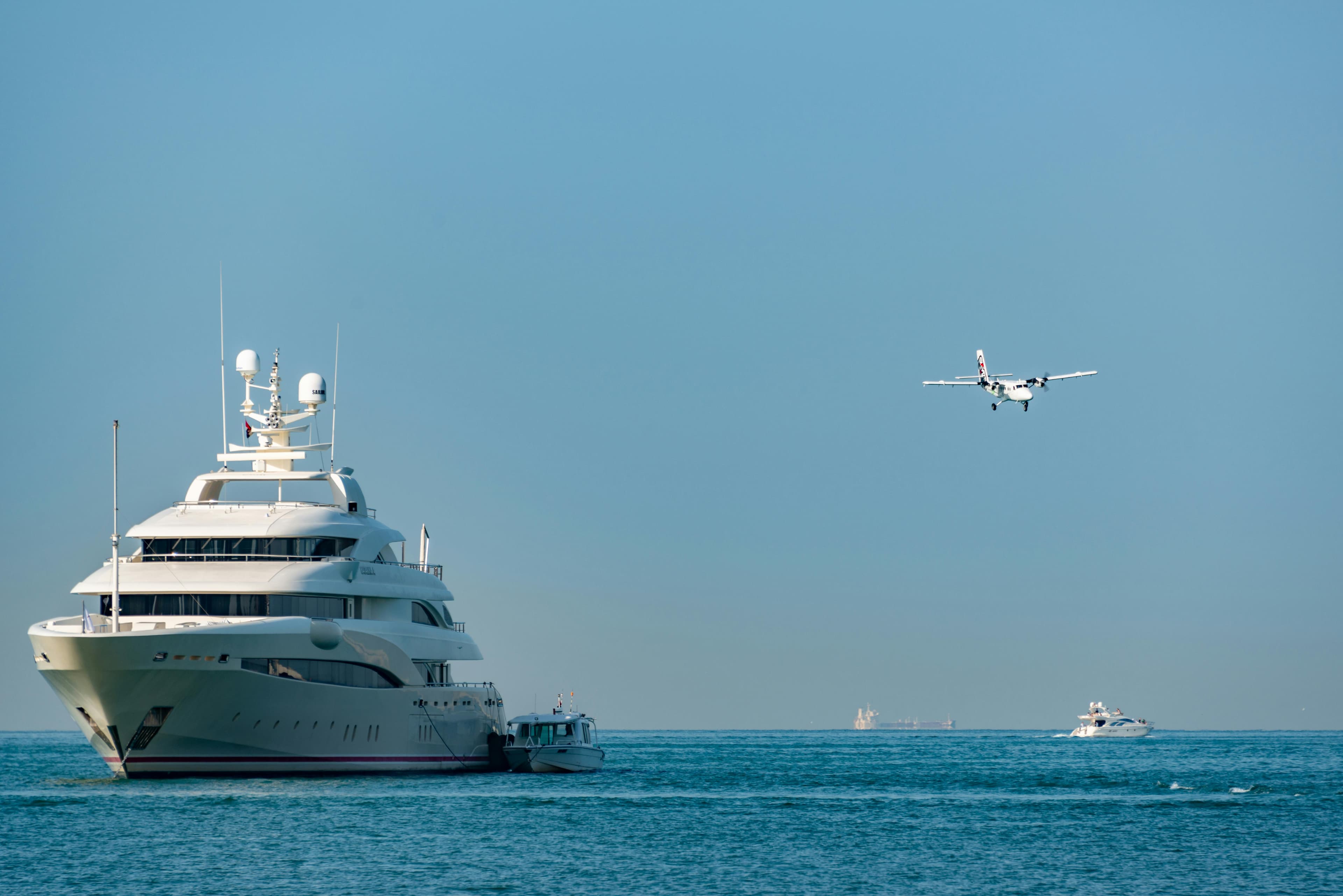
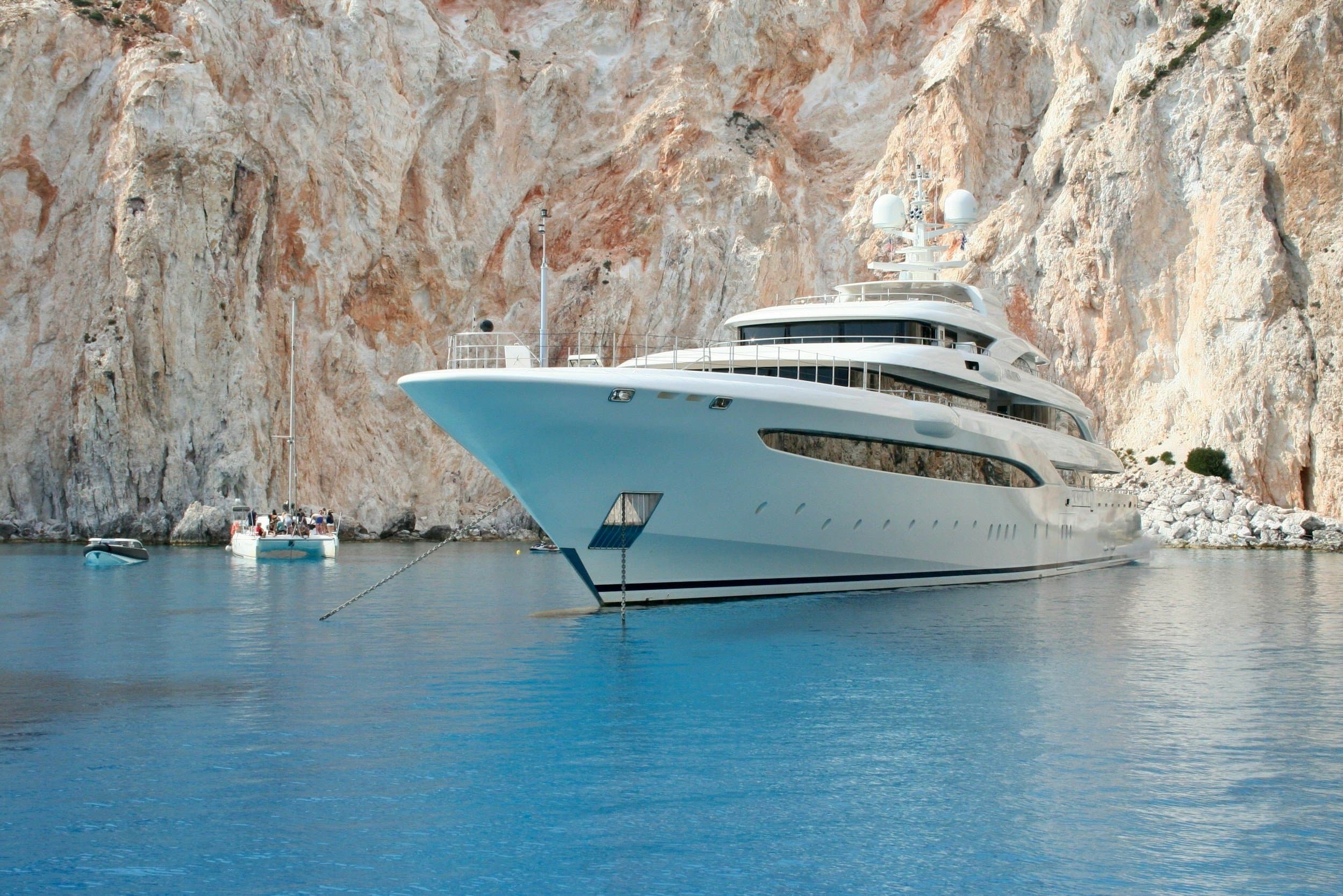
A motor yacht in the 90 to 110 foot range — call it a Sunseeker 95, a Hatteras 100, a Benetti in the lower range — is a different animal. You get separation. The master is a real master, usually full-beam amidships, with a head that feels like a hotel bath. The VIP forward is a proper second suite. There is a sundeck with a hot tub, an upper salon, a main salon, and an aft deck dining setup that seats your eight without anyone bumping elbows. Crew is typically four to six: captain, mate, engineer, chef, and one or two stews. Service is closer to a small hotel than to a sailboat.
What you actually buy with a motor yacht is two things: speed and formality. Speed means you can leave Tortola at nine, be on a mooring at The Baths by ten-thirty, and be in North Sound for lunch. It means a day trip to Anegada doesn't eat the whole day. It means if the group wakes up on Wednesday and decides they want to be in St. Barts by Thursday afternoon, the captain can actually do that — a 22-knot cruise turns a 90-mile passage into something under five hours.
Formality means the chef has a dedicated galley and a stew running plates, the table is dressed properly, and the evening has a different shape. Some groups want that. Others find it stiff on a boat where the whole point is to be barefoot.
The costs are real. Fuel on a 100-foot motor yacht running an active itinerary will burn through an APA line item that a sailing cat doesn't touch — figure four to six times the fuel spend across a week. Dockage when you take a slip rather than a mooring is priced by length overall, and a 100-footer at Yacht Haven Grande or Nanny Cay is meaningfully more than a 70-foot cat. The base charter rate itself runs roughly 1.8 to 2.5 times a comparable sailing catamaran for the same guest count.
How to actually choose
The decision comes down to four questions, and they're not the questions most brokers ask.
How does your group spend the day? If the answer is "in and out of the water constantly, with the swim platform as the center of gravity," you want a catamaran. If the answer is "long lunches, afternoon cocktails on the sundeck, and a proper dinner," you want a motor yacht.
How tight is the itinerary? A BVI-only week with no plans to leave the territory does not need a motor yacht's range. A two-territory week — BVI plus St. Martin, or BVI plus Anguilla and St. Barts — starts to argue for one.
Who is on the boat? Eight adults who know each other well live happily on a 70-foot cat. Eight adults who are two couples plus a business associate and his partner plus the host couple's adult kids — that's a group that benefits from the separation a motor yacht offers. The cabins matter less than the public spaces.
What is your tolerance for crew presence? A catamaran crew of three is around all day in a small footprint. A motor yacht crew of five is more present in service but easier to disappear from, because the boat is bigger. Some clients love the closeness of a cat crew by day three. Others find it exhausting.
If you want us to walk through your specific group and dates before you commit, start a quote and we'll come back with two or three boats of each type, with honest notes on each.
The numbers, roughly
For a winter week in the BVI, eight guests, high season but not Christmas:
- Crewed sailing catamaran, 70–75 ft: base rate $55,000–$85,000, plus APA at 30–35% covering fuel, food, dockage, and bar.
- Power catamaran, 60–70 ft: base rate $65,000–$95,000, APA 30–35%, fuel a meaningful line item.
- Motor yacht, 95–110 ft: base rate $120,000–$200,000, APA 30%, fuel and dockage materially higher in absolute dollars.
These are working ranges, not quotes. Christmas and New Year's are a different market entirely — typically a 15–25% premium and a hard minimum of ten days on most quality boats, booked twelve to eighteen months out.
Worth noting: the APA — Advance Provisioning Allowance — is not a tip and not a deposit. It's a working fund the captain draws against for fuel, dockage, provisioning, and incidentals during your week. Whatever's left at the end is refunded. A captain who runs a tight APA and reconciles cleanly is a sign of a well-run boat. We talk through how we vet that on the about page.
FAQ
Is a catamaran really more stable than a motor yacht at anchor?
At anchor, yes — a catamaran's two hulls give it a much wider stance, so it rolls less in beam swell. Underway it's a different conversation: a modern motor yacht with active stabilizers will run more comfortably in a chop than a sailing cat under power, particularly on a long passage. For a BVI week with short hops, the at-anchor stability of the cat is what most guests notice.
How many crew should I expect for eight guests?
On a sailing catamaran, three is standard — captain, chef, and a stew, sometimes a fourth in peak season. On a power cat in the 60–70 foot range, three to four. On a 95–110 foot motor yacht, four to six, including a dedicated engineer. More crew means more service and more presence; fewer crew means a closer, more informal week.
Can either boat handle Anegada comfortably?
A catamaran is the easier answer for Anegada — the shallow draft and the mooring field at Setting Point are friendlier to a cat. A 100-foot motor yacht can absolutely make the trip, but the captain will be more selective about where he sets the hook, and on a windy day it can be a less restful overnight. Most experienced BVI motor yacht captains will do Anegada as a long lunch rather than a sleepover.
What does APA actually cover, and how much should I budget?
APA covers fuel, dockage, provisioning, bar, and incidentals — anything consumed during your charter. Standard is 25–35% of the base rate, paid before boarding. The captain reconciles at the end of the week and refunds the balance. On a motor yacht running an active itinerary, expect to use most of it. On a sailing cat with quiet days, expect a meaningful refund.
How far ahead should I book?
For a winter BVI week excluding the holidays, four to six months is comfortable. For Christmas, New Year's, or Presidents' Week, twelve to eighteen months is realistic for the better boats. The top ten percent of the fleet — the boats with the chefs you actually want — go first.
Can I mix and match — fly into St. Thomas, board in the BVI?
Yes, and most of our clients do. The standard pattern is a private flight into St. Thomas or Beef Island, a pre-arranged transfer to the marina, and a Sunday-to-Sunday boarding window. Customs clearance into the BVI is handled by the captain. If you want us to coordinate the air, ground, and boat as one piece, reach out directly and we'll build the whole week.
None of this is complicated once you know the questions. The boat is a week of your life — pick the one that matches how your group actually wants to spend it, not the one that looks best in the listing photos.