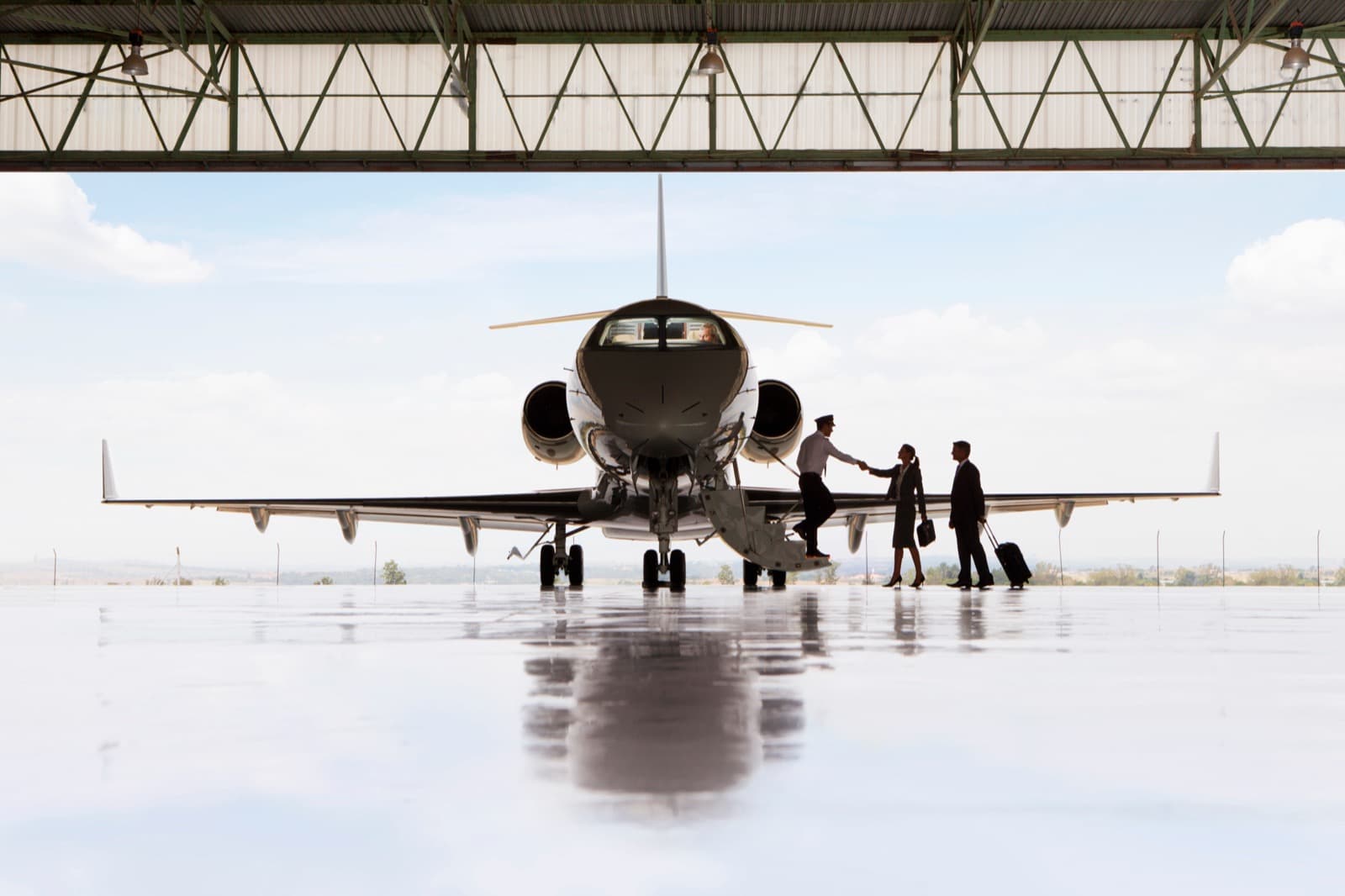
A client called last month asking why a Falcon 2000LXS quote came in twelve thousand an hour while a Challenger 350 for the same Teterboro–Aspen leg landed at nine. Same range on paper. Both can do the trip nonstop in winter winds. Both seat eight comfortably. The difference looked like markup. It wasn't.
The gap between heavy jet and super-midsize hourly pricing is real, structural, and almost entirely about what's happening underneath the cabin floor — not what's being charged on top. If you're going to spend the money, you should know what the money is doing. Here's the working version.
The hourly rate is a stack, not a number
When an operator quotes you a wet hourly rate, they're rolling a dozen line items into one figure. Fuel. Crew pay and per diem. Maintenance reserves. Engine programs. APU programs. Insurance. Hangar. Training. Overhead and margin. The headline number hides which of those are linear with aircraft size and which are not.
Fuel is the obvious one. A super-midsize like a Challenger 350 burns roughly 280 gallons per hour at cruise. A heavy like a Falcon 2000LXS burns closer to 360. A Gulfstream G450 will pull 400 plus. At today's jet-A pricing, that's a meaningful gap before you've added anything else — call it $400 to $700 per hour just in fuel, depending on the FBO and the day.
But fuel is the easy half. The harder half is the maintenance reserves. Every hour a jet flies, the operator is setting aside money against future events — engine overhauls, landing gear cycles, APU hot section inspections, avionics database subscriptions, paint, interior refurb. On a heavy jet those reserves are not 30% higher than a super-midsize. They're often double. The engines are bigger, the parts are more expensive, the inspection intervals are tighter in some categories, and the shops that do heavy-jet work charge more per labor hour because fewer of them are qualified.
This is why two aircraft that look similar on a range map can sit a thousand dollars apart per hour even before crew and fuel.
Engine programs do most of the talking
The single biggest line item buried in your hourly rate is usually the engine program — Rolls-Royce CorporateCare, Pratt & Whitney ESP, Honeywell MSP. These are pay-by-the-hour maintenance contracts the operator carries on each engine. The rate is set by the manufacturer based on the engine model, and it's not negotiable.
A pair of Honeywell HTF7350s on a Challenger 350 runs the operator something in the neighborhood of $900 to $1,100 per flight hour combined. A pair of PW308Cs on a Falcon 2000LXS runs $1,400 to $1,700. The Rolls-Royce BR710s on a G550 are higher still. That delta — three to six hundred dollars an hour, just for engine reserves — flows directly into your quote. It is not markup. It is the manufacturer's bill.
When we source aircraft on the jet side, this is one of the first things we look at on an operator's fleet sheet. An operator running engines off-program is cheaper to charter and a worse risk to fly. We don't book those.
Crew, dispatch, and the cost of a third pilot
A super-midsize is a two-pilot airplane. So is most of the heavy fleet — but heavy operators flying long international legs often staff a third crew member, either an augmenting pilot for duty time relief or a flight attendant who's actually trained on the type. Both cost money.
A cabin attendant on a heavy is typically not optional past about six hours of flight time, and on a super-midsize is genuinely optional and often skipped. That's another $1,200 to $2,500 per day in crew cost, plus per diem, plus a hotel room on overnights, plus positioning if the attendant wasn't based where the trip starts.
The captains on heavy iron also cost more. A senior Gulfstream or Falcon captain with international experience and the type ratings to match is paid 25–40% above a super-midsize captain in the same market. Operators pass that through. They have to — those pilots are not interchangeable, and the training pipeline to make new ones is two years deep.
Dispatch and ops support is the quiet third leg. A flight department running heavies is usually doing more international work, more handler coordination, more overflight permits, more customs choreography. The ops desk that supports a Global 6000 looks different than the one supporting a Citation Latitude. That cost lives in overhead, and overhead lives in your hourly.
Why the same range doesn't mean the same trip
A Challenger 350 and a Falcon 2000LXS will both fly Teterboro to Aspen direct. On a calm day in May, they'll do it in roughly the same block time. So the reader's fair question is: if the trip is the same, why isn't the price?
Because the trip isn't actually the same. The heavy will do it with more reserve fuel, in a wider cabin, with a stand-up lavatory, with a galley that can plate a hot meal, and — critically — with the runway and weight performance to do the same trip in February with a full load and an icy short runway at KASE without thinking about it. The super-midsize can do the trip. The heavy can do the trip in conditions where the super-midsize would need to drop pax, drop bags, or tech-stop in Rifle.
You are not paying for range on paper. You are paying for the margin around the mission. That margin is what shows up in the hourly.
When the heavy is worth it, and when it isn't
This is the part of the conversation that usually doesn't happen, because the broker on the other end of the phone is incentivized to upsell. So let's be direct.
The heavy is worth it when:
- You're flying eight or more, or you're flying six with real luggage (ski gear, golf bags, a dog crate, a stroller).
- You're going more than four hours in the air and you actually want to sleep, work, or eat a real meal.
- You're flying transatlantic or to Hawaii, where range margin and over-water equipment matter.
- You're operating into short or hot-and-high airfields with a full load — Aspen in winter, Telluride, St. Barths feeders, parts of Mexico.
- The trip has a high-stakes return leg where weather diversions would cost more than the rate delta.
The super-midsize is the right answer when:
- You're flying four to six people, domestic, three to four hours block time.
- The mission profile is repeatable — the same coastal hop you do twice a month.
- You want a stand-up cabin and a real lavatory but don't need a galley or a flight attendant.
- You're optimizing total spend across a year of flying, not the comfort of one trip.
The honest math: for a typical 3.5-hour domestic leg with six passengers and standard bags, a super-midsize will cost you 25–35% less than a heavy and deliver 90% of the experience. For a 7-hour transcon with eight passengers and a working dinner, the heavy is not a luxury — it's the right tool.
We walk clients through this on every quote we put together, and the answer changes by trip. The same client flies super-mid on Tuesdays and heavy on Fridays. That's not inconsistency. That's matching the airplane to the day.
A note on the "light heavy" middle ground
There's a category that confuses this conversation: the so-called super-midsize-plus or light-heavy aircraft. The Praetor 600. The Challenger 3500. The Citation Longitude. These airplanes have heavy-jet range on paper, super-midsize hourly economics, and a cabin somewhere in between. They're priced 10–20% above a true super-midsize and 15–25% below a true heavy.
For a lot of missions they are the right answer. They also have real tradeoffs — narrower cabins than a Falcon, smaller galleys, less baggage volume, and operator availability that's still maturing in some markets. We use them often. We don't pretend they're heavies.
What you're actually buying when you pay the heavy premium
Strip it all down and the heavy-jet hourly premium pays for four things: bigger engines burning more fuel, more expensive engine and airframe maintenance reserves, a more senior and sometimes larger crew, and the operational margin to do the same mission in worse conditions with more people and more weight.
None of that is markup. All of it is real cost the operator is incurring whether you fly or not, and amortizing across the hours the airplane actually flies in a year. The reason a heavy jet hourly rate looks high is that heavy jets don't fly enough hours per year to spread that fixed cost thin. A super-midsize in a busy charter fleet flies 700–900 hours a year. A heavy in the same fleet flies 500–700. Fewer hours, same reserves, higher rate.
This is also why fractional and jet card pricing on heavies is structurally different than charter — the card programs are pooling demand to push utilization up and the per-hour cost down. That's a different conversation, and one we're happy to have when you reach out about a specific mission profile.
The takeaway is simple. The hourly rate is a window into the airplane's economics. Read it that way and you'll stop arguing about price and start asking the better question: which airplane is right for this trip, this load, this weather, this airport. Get that right and the rate sorts itself out.
FAQ
Is a heavy jet always faster than a super-midsize?
No. Cruise speeds are similar — most super-midsize jets cruise at Mach 0.80 to 0.82, and most heavies cruise at Mach 0.80 to 0.85. On a 3-hour leg the block time difference is often under 10 minutes. The heavy's advantage is range and cabin, not speed.
Why does the same heavy jet cost different rates from different operators?
Fleet age, engine program status, crew tenure, hangar costs, insurance history, and utilization. An operator flying a 2019 Falcon 900 LX 800 hours a year on full engine programs will quote differently than one flying a 2008 example off-program at 400 hours. Both are legal. Only one is a fleet we'd put a client on.
Can I save money by booking a one-way or empty leg on a heavy?
Sometimes — but heavy empty legs are rarer than super-midsize ones because the fleet is smaller and the routings are more international. When they appear, the savings are real (often 40–60% off the round-trip rate), but the schedule and routing are fixed. They're a tool for flexible travelers, not a planning method.
How much should crew and catering add to a heavy-jet quote?
Crew per diem and overnight costs typically run $400–$800 per overnight per crew member. A flight attendant adds roughly $1,500–$2,500 per day all-in. Catering on a heavy is whatever you order — figure $75–$200 per passenger for a real meal versus $25–$50 for a standard light spread.
Is the maintenance reserve charge negotiable?
No. Maintenance reserves and engine program rates are set contractually between the operator and the manufacturer or program provider. A broker who tells you they negotiated those down is either misrepresenting what they did or working with an operator cutting corners somewhere else.
What's the break-even where a heavy starts making sense?
Roughly: more than six passengers with bags, or more than 4.5 hours of block time, or any mission with meaningful runway/weather margin requirements. Below that, a super-midsize or light-heavy is usually the better-value answer for the same trip.
The right airplane for your trip is rarely the most expensive one on the ramp, and rarely the cheapest. It's the one matched to the mission. Send us the trip and we'll show you the math.