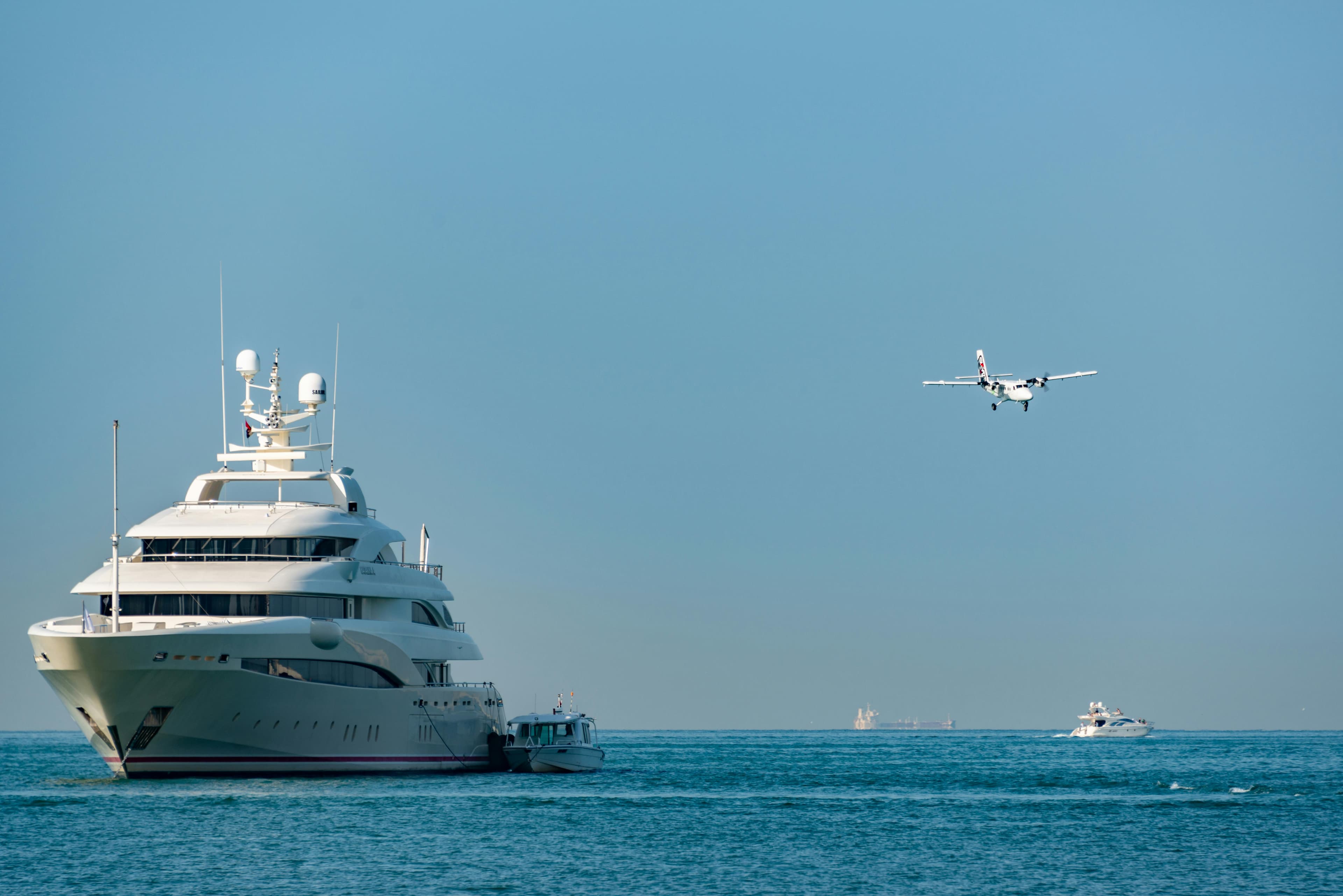
A Mediterranean yacht charter in summer 2026 across Sardinia and Corsica is not a booking — it's a positioning problem. The yachts you actually want are already locked into a July-August rotation that was settled months ago. By the time most people start asking about Porto Cervo for the second week of August, the boat they're imagining is either gone or repositioning to the Balearics for someone who called in February.
This isn't a doom note. It's just the shape of the trade. The Tyrrhenian — the water bounded by Sardinia to the west, the Italian mainland to the east, Sicily to the south, and Corsica clipping the top — is the most concentrated crewed motor yacht market in Europe during peak weeks. More 40m-plus boats per square nautical mile than anywhere outside Monaco week. If you understand how the season is built, you can still get a great week. If you don't, you'll end up on the wrong boat, in the wrong port, on the wrong night.
Why Sardinia and Corsica Sit at the Center of the Season
Costa Smeralda is the gravity well. The Aga Khan developed it in the 1960s specifically as a port-of-call for serious yachts, and Porto Cervo's Marina was built around that premise — deep draft, generous beam allowances on the outer quay, and a club culture (Yacht Club Costa Smeralda hosts the Maxi Yacht Rolex Cup in September) that keeps the fleet anchored in the area straight through summer. When you see a 60m motor yacht sitting on the quay across from the Promenade du Port, that boat is usually not transient. It's based there for the season.
The knock-on effect: tender traffic in and out of Cala di Volpe and Liscia Ruja is dense from mid-July. Berths at Porto Cervo for anything over 40m are negotiated through the harbourmaster, often months in advance, and the marina runs at functional capacity for the first three weeks of August. If your week falls in that window, the captain needs to know the berth situation before you sign — not after.
Corsica plays a different role. Bonifacio, on the southern tip, is the natural crossing point from Sardinia — about 7 nautical miles across the Strait of Bonifacio, weather depending. The harbor itself is a limestone fjord, dramatic on approach, but the inner port is tight and shallow on the south side. Most yachts over 50m anchor outside or use the outer quay. North of Bonifacio, the western Corsican coast — Girolata, the Scandola Reserve, Calvi — is the quietest stretch of cruising in the region. UNESCO-protected Scandola has anchoring restrictions you need to brief on before the day starts, not after the tender drops.
The third leg, when clients want it, is Amalfi — Capri, Positano, Ischia. That's a 180-nautical-mile passage from northern Sardinia, usually run overnight. It's a different trip in feel. More restaurants, more press, more tender chaos at Marina Piccola in Capri. We push some clients toward it for the back half of a 10-day charter. Others we keep in Sardinia and Corsica the entire week because the cruising is better and the ports are less crowded outside Porto Cervo itself.
What Size Yacht Actually Fits the Itinerary
The question we get most often is what size boat to take, and the honest answer is that it depends on what you want the week to feel like.
30 to 40 meters
This is the sweet spot for a couple, a family of six, or two couples. Most boats in this band carry four to six crew, sleep eight to ten in four or five cabins, and have the draft and maneuverability to use the smaller anchorages — La Maddalena archipelago, the granite coves around Cala Coticcio, the western Corsican beaches. You can tuck into places a 60m boat will never see. Tender capability is usually one chase boat plus a couple of toys. Range covers the Sardinia-Corsica-Amalfi triangle without strain.
40 to 55 meters
More staterooms, real beach club, often a proper gym, sometimes a helipad on the larger end. Crew counts move to eight to twelve. The trade-off is you lose some of the intimate anchorages — you're anchoring further out, tendering longer to shore. For groups of ten to twelve, or a family that wants the children's nanny and a chef and proper service standards across a 10-day run, this is the band.
55 meters and up
Different product entirely. Full-time captain, often a chief stew with a hospitality background out of a five-star hotel, helicopter on board, submersible on a few of them now. The cruising calculus changes: you're not really anchoring off small Corsican beaches. You're positioning the mothership in a deep-water spot and using helicopter or chase tender for shore movements. The week is built around the boat as a destination rather than as a tool for reaching destinations.
We walk through this on every brief at our yacht charter desk. The wrong-sized yacht is a more common mistake than the wrong port. A family of five on a 65m boat will rattle around. A group of twelve on a 38m will be on top of each other by day four.
What a Real 7 to 10 Day Itinerary Looks Like
A workable Tyrrhenian week is not a fixed line on a chart. It's a frame the captain adjusts daily based on wind, swell, and what the guests actually want once they're aboard. But the frame usually looks something like this.
Day one — board in Olbia or Porto Cervo, depending on where the boat is positioned and where your jet lands. Olbia Costa Smeralda Airport (LIEO) handles the GA traffic; the FBO is reasonable but congested in August, so slot times matter. We coordinate the ground transfer from the FBO to the marina down to the minute, because Porto Cervo traffic in August will eat a casual plan alive. Light dinner aboard, short cruise to a quiet anchorage off Cala di Volpe or Liscia Ruja for the first night.
Days two and three — the Maddalena archipelago. Spargi, Budelli (the famous pink beach, viewable but no longer landable since 1994 conservation rules), Santa Maria. This is where the toys come out — seabobs, e-foils, paddleboards. Lunch on board at anchor. One night you'll likely take the tender into Porto Cervo for dinner — Phi Beach for sunset, then dinner at one of the rotation of restaurants the captain has standing relationships with.
Day four — crossing to Bonifacio. Short run, but the Strait can build chop in the afternoon mistral, so the captain will usually push off early. Lunch at anchor in the calanques south of the town, then up into the harbor in the late afternoon for the cliffside view. Dinner in the old town.
Days five and six — up the western Corsican coast. Girolata is the highlight for most guests — a tiny village reachable only by boat or a long hike, set inside the Scandola Reserve. The water is clear in a way the Sardinian side rarely is. Anchoring restrictions apply, so the captain will pre-clear the spot.
Days seven through ten — depending on length, either work back south through La Maddalena for a final stretch in Sardinia, or push east to the Amalfi coast for the back half. The Amalfi run we treat as a second trip — different rhythm, different shore plan, different restaurant relationships.
Disembarkation is usually back in Olbia or, if the boat is repositioning, in Naples or Civitavecchia with a jet leg home from there.
Why Booking in April Is Already Late
The charter calendar for peak Mediterranean weeks — roughly the last week of July through the third week of August — is built in two stages. First-refusal goes out to repeat clients in October and November of the prior year. By January, the boats with strong central agents are largely placed for their peak weeks. By March, the second tier is committed. By April, what's left is either the boats that didn't book on first refusal (which tells you something), or repositioning gaps where a yacht is moving between two committed charters and has a five-or-six-day window.
Those repositioning gaps can be excellent — sometimes the best value of the season, on boats that would otherwise be unreachable — but they require flexibility on the date and on the start and end port. If your week is fixed and your ports are fixed, the work needs to start in winter, not spring.
The Maxi Yacht Rolex Cup in early September is one of the events we watch closely — the fleet positioning around that regatta affects availability in late August, and a yacht committed to host owners or sponsors for the event is unavailable the prior week regardless of what a broker tells you. The Cannes Yachting Festival in early September pulls similar attention. These aren't problems if you know about them in February. They're problems if you find out about them in May.
The other thing worth knowing: APA — the advance provisioning allowance — runs 25-35% of the base charter fee on most contracts, and it covers fuel, dockage, food, beverage, and shore expenses. In the Tyrrhenian in August, with Porto Cervo berthing fees what they are and fuel burn on a long crossing day what it is, APA gets consumed faster than first-time charterers expect. A good broker walks you through realistic burn rates before you sign so the invoice at the end isn't a surprise.
FAQ
When should I book a Sardinia or Corsica yacht charter for summer 2026?
For peak weeks — late July through the third week of August — serious planning should be underway by January 2026, and ideally earlier for boats over 50 meters. By April, you're working from what's left rather than what's best. Shoulder weeks in late June and early September offer better availability and often better weather.
What's the difference between chartering out of Porto Cervo versus Olbia?
Olbia is where most guests fly in — Costa Smeralda Airport handles the private jet traffic. Porto Cervo, about 30 minutes north by car, is where the yachts are berthed. You'll almost always fly into Olbia and transfer to wherever the boat is positioned. The captain will recommend the embarkation port based on the boat's schedule and the first day's cruising plan.
Can a 7-day charter realistically cover Sardinia, Corsica, and Amalfi?
Not comfortably. Seven days is enough for Sardinia and Corsica, with a focus on La Maddalena and the southern Corsican coast. Adding Amalfi pushes you into 10 days minimum, because the crossing from northern Sardinia to Capri is roughly 180 nautical miles and eats most of a day on each end.
What does APA cover and how much should I budget?
APA — advance provisioning allowance — typically runs 25-35% of the base charter fee and covers fuel, port and dockage fees, food and beverage, and shore expenses tendered through the boat. In the Tyrrhenian in August, with high fuel burn on crossing days and significant berthing fees in Porto Cervo, APA can run at the higher end. Your broker should walk you through realistic consumption before you sign.
Are there anchoring restrictions I should know about in Corsica?
Yes. The Scandola Nature Reserve on the western Corsican coast is UNESCO-protected and has strict anchoring rules — designated zones only, and certain areas are no-anchor at all. Bonifacio's inner harbor has draft and beam constraints. A captain who runs this water regularly will have all of this pre-cleared. One who doesn't is a flag.
What size yacht is right for a family of eight?
A family of eight is usually best served by a 35 to 45-meter motor yacht — four to five cabins, six to eight crew, enough beach club and toy capacity for active days, but small enough to use the better anchorages. We walk through specific boats once we know ages of the children, any dietary or accessibility considerations, and what the days are meant to feel like — tell us about the trip and we'll narrow the shortlist.
If you've chartered before, none of this is news. If you haven't, the thing to take from it is that the Tyrrhenian in August rewards early decisions and punishes late ones. The boats are real, the crews are real, and the relationships that get a 50-meter onto the Porto Cervo quay on a Saturday in August were built over years, not weeks.