Booking a private jet Monaco Grand Prix 2026 trip is the easiest part of race weekend to overpromise and the hardest part to actually execute. The race is scheduled for the last weekend of May 2026 — Thursday practice, Saturday qualifying, Sunday race — and every operator in Europe knows it. Slots at Nice Côte d'Azur (LFMN/NCE) get restricted weeks out. Hangarage in the region disappears. Helicopter transfer windows into Monaco compress to the minute. If you're flying in from the U.S., the routing decisions you make in February shape what your Sunday morning actually looks like.
This is what we tell clients who are doing this for the first time, and what we re-confirm with the ones who've done it for a decade. The race doesn't change. The operational picture around it does, every year.
The transatlantic leg: TEB or BED, not JFK
If you're departing the East Coast, you're almost certainly leaving from Teterboro (KTEB) or Hanscom (KBED). Westchester (KHPN) is possible but the perimeter rule and curfew make it less flexible. From TEB, a heavy jet — Global 6000, Falcon 7X, Gulfstream G550 or G650 — will run nonstop to Nice in roughly 7 hours 30 minutes to 8 hours depending on winds. A super-mid like a Challenger 350 or Praetor 600 won't make it nonstop with a full cabin; you're looking at a tech stop in Shannon (EINN), Keflavík (BIKF), or St. John's (CYYT) depending on weight and weather. That stop adds 60 to 90 minutes wheels-down to wheels-up if it's properly handled in advance.
The category decision matters more than people realize. A Global flying nonstop with eight passengers and bags lands you in Nice rested and on schedule. A super-mid with a fuel stop, in race-week traffic, with crew duty time pressing — that's where trips start to slip. We've talked through the eight aircraft categories we work across on the service page, but the short version: for transatlantic to Nice during race week, fly heavy or ultra-long-range. The math works out.
Crew duty and the 14-hour wall
FAR Part 135 crew duty limits cap a two-pilot crew at 14 hours of duty in a day, with 10 hours of flight time. A nonstop TEB–NCE eats most of that envelope. If your departure slips three hours on the front end — weather, a late passenger, a slot delay — your crew may legally not be able to complete the flight without a rest period or augmented crew. This is why operators with deep transatlantic experience pre-position crews or bid the trip with three pilots from the start. It's a question you should ask before you sign the trip sheet, not on the ramp at 9 PM.
LFMN slots, handling, and why Cannes-Mandelieu is not the answer
Nice Côte d'Azur is the only sensible jet arrival for Monaco. LFMN runs a slot coordination program year-round, and during Grand Prix week — along with Cannes Film Festival, which often overlaps the front half of May — slots are managed through Eurocontrol's CFMU and the airport's own coordinator. You don't just file and go. Your operator submits a slot request, gets a CTOT (Calculated Take-Off Time) for the inbound, and works the parking allocation separately with the FBO.
Parking is the bottleneck. Nice has limited jet stands, and during race week most of them are pre-allocated to based aircraft, repositioned aircraft, and operators with year-round relationships. A drop-and-go — land, deplane passengers, depart empty to park elsewhere — is the most common pattern. Your aircraft might reposition to Cannes-Mandelieu (LFMD), Cuneo (LIMZ) over the Italian border, or as far as Marseille (LFML) or Toulon (LFTH) for the weekend, then return Sunday evening for the outbound.
People ask about flying directly into Cannes-Mandelieu to skip the Nice complexity. LFMD has a 1,576-meter runway, restrictive noise rules, and a hard limit on aircraft category — heavy jets are not welcome. It works for a Phenom 300 or a Citation XLS. It does not work for a Global. Don't let anyone tell you otherwise.
Customs and the Schengen entry
If Nice is your first European stop, that's where you clear Schengen. French customs at LFMN is professional and reasonably quick during race week, but build in 20 to 30 minutes minimum. If you tech-stop in Shannon, you've already cleared into the EU there and Nice becomes a domestic-equivalent arrival — faster, but you've added a stop. The trade-off is real and worth modeling against your arrival timing.
Ground from Nice to Monaco: helicopter, car, or both
The distance from Nice airport to Monaco is roughly 22 kilometers along the A8. By car, in normal traffic, that's 35 minutes. During race week, the same drive can take 90 minutes to two hours, especially Thursday afternoon and Saturday evening. The Moyenne Corniche and the lower coastal road both choke. This is why nearly every serious arrival into Monaco for the Grand Prix uses the helicopter shuttle.
Monacair operates the heliport at Fontvieille (LNMC), and the transfer from Nice is seven minutes in the air. Slots during race week are tight and need to be booked in advance — we coordinate them as part of the arrival plan. Six passengers per AS355 or H130, bags managed separately or compressed. From Fontvieille heliport you're five minutes by car to anywhere in Monaco. Our ground program handles the car side end-to-end so the helicopter, the driver, and the villa or yacht arrival are all on the same clock.
If the weather goes down — and it can, especially with the Mistral or low marine layer — the helicopter doesn't fly. You're driving. Build that contingency into the schedule. A Sunday morning with the helo grounded and a 90-minute drive to the Principality is not the morning you want.
The harbor question: yacht charter for race viewing
The race runs through the streets of Monte Carlo, but the best seat in the house has been Port Hercule for forty years. Yachts berthed in the harbor — or anchored in the bay with tender access — give you a hospitality platform, accommodation, and a view of the chicane and the swimming pool section that no grandstand matches. Demand far exceeds berth supply. Monaco Yacht Club and the Société d'Exploitation des Ports de Monaco allocate Grand Prix berths through a process that begins the previous summer; by January, the harbor is largely committed.
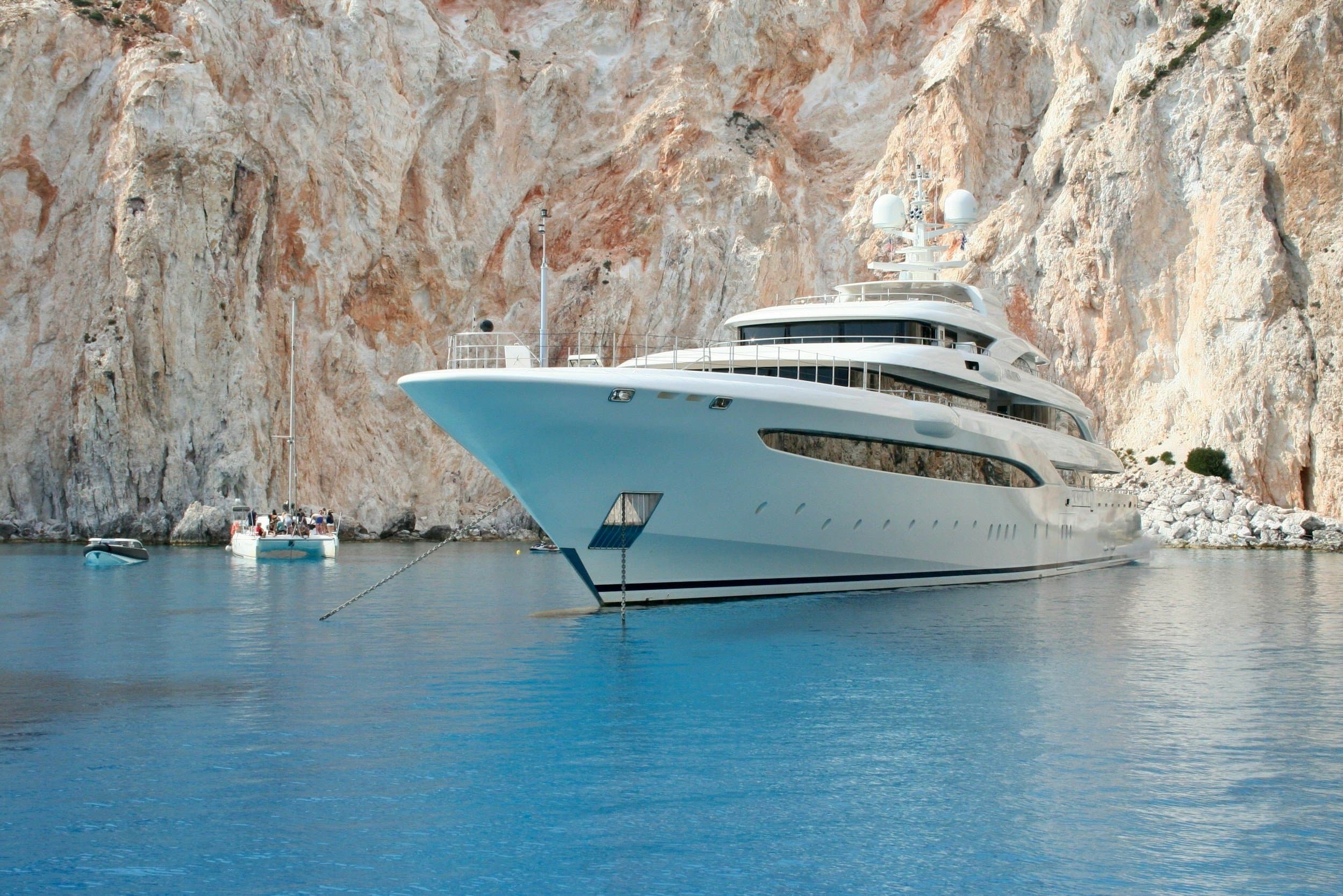
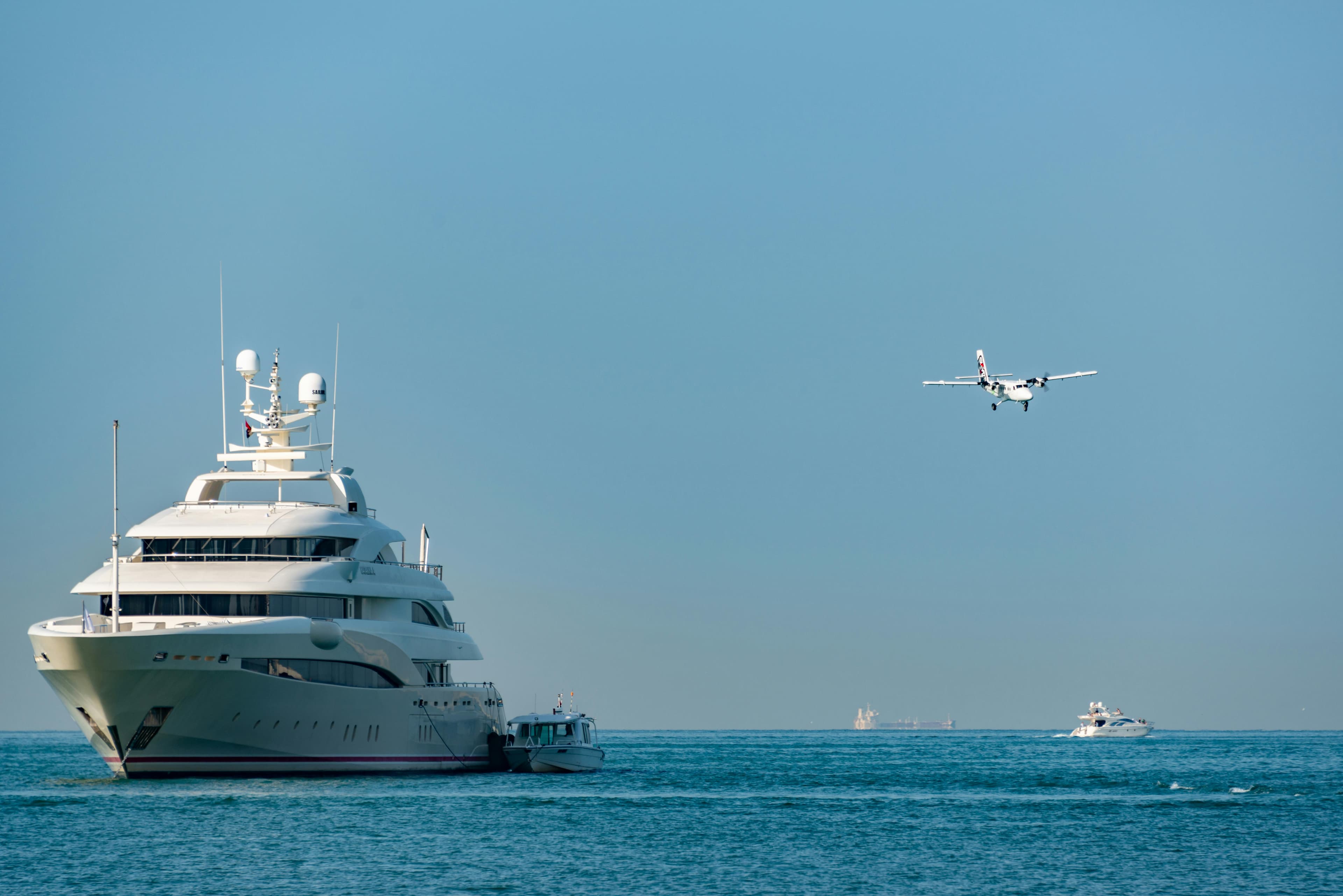
This is where a charter yacht earns its keep. A 40-to-60-meter motor yacht chartered for race week, berthed in Port Hercule with a confirmed Grand Prix slip, gives you a private base for Thursday through Sunday — meals, sleep, hospitality for ten to twenty guests, and direct sightlines. We coordinate jet, yacht, and harbor logistics together because the timing of when the boat arrives, when guests board, and when the harbor closes for race operations all interact. APA (Advance Provisioning Allowance), VAT in French waters versus Monegasque waters, and crew gratuity all need to be sorted in writing well before arrival.
If a harbor berth isn't available, the alternative is anchoring in the bay off Larvotto or further west toward Cap d'Ail, with tender service into Monaco. The view is different — you see the city, not the corners — but the boat as a base still works. Some clients prefer it: quieter, less foot traffic, easier departures.
Villa as the third option
For families, or for clients who want a longer trip with the race as the centerpiece, a villa in Roquebrune-Cap-Martin, Èze, or Saint-Jean-Cap-Ferrat gives you the South of France for a week with day trips into Monaco for sessions. The race weekend itself you'd still want a hospitality position closer in — a yacht day-charter, a Paddock Club ticket, or a friend's apartment on the circuit. Our villa side typically pairs a 10-to-14-day stay with three or four days of Monaco access rather than trying to make the villa do everything.
Departure Sunday: the hardest part of the trip
Everyone wants to leave Sunday evening or Monday morning. LFMN handles it, but not gracefully. CTOT delays of two to four hours are routine on race Sunday. The smarter pattern: depart Monday midday, or stage out of a secondary airport — Cuneo (LIMZ), Genoa (LIMJ), or Saint-Tropez (LFTZ) — where your aircraft has been parked since Friday. The reposition flight in is short, the slot pressure is lower, and you're wheels-up faster.
If you're returning transatlantic, the eastbound winds that helped you on the way over now work against you. NCE–TEB is typically 8.5 to 9.5 hours nonstop in a heavy jet, which once again puts crew duty in play. Plan the departure window around the crew, not the other way around. We sort all of this on the quote and trip planning side before anyone signs.
FAQ
When should I book a private jet for the 2026 Monaco Grand Prix?
For transatlantic trips, the practical window is November 2025 through January 2026. Aircraft availability tightens fast after the new year, and slot allocations at LFMN are easier to secure with lead time. Yacht berths in Port Hercule are typically committed by the previous July or August, so if the harbor is part of your plan, that conversation has to happen even earlier.
Can I fly directly into Monaco?
No fixed-wing airport exists in Monaco. The Principality has a heliport at Fontvieille (LNMC) but no runway. All jet arrivals route through Nice (LFMN) and connect by helicopter, car, or yacht tender. Nice is the only sensible option for heavy jets; Cannes-Mandelieu (LFMD) accepts smaller aircraft only and has restrictive noise and category rules.
How long is the helicopter transfer from Nice to Monaco?
Seven minutes in the air. Including arrival processing at Nice, transfer to the helicopter terminal, the flight, and the short drive from Fontvieille heliport to your final destination, plan on 45 minutes door-to-door. Weather can ground the helicopter — Mistral winds and low cloud are the usual culprits — so always have a car as backup.
What aircraft category should I charter for a U.S. to Nice trip?
For East Coast departures with passengers and bags, a heavy or ultra-long-range jet — Global, Gulfstream G550/G650, Falcon 7X/8X — is the practical answer for nonstop service. Super-midsize aircraft can do the trip with a fuel stop in Shannon, Keflavík, or St. John's, which is fine for cost-conscious trips but adds time and complexity. From the West Coast, ultra-long-range is essentially required.
Is a yacht charter worth it just for race weekend?
It depends on group size and viewing priority. For ten or more guests over four days, with harbor access, a chartered yacht in Port Hercule is often the most efficient combination of accommodation, hospitality, and viewing. For a smaller group or a single race-day visit, a yacht day-charter or grandstand and Paddock Club tickets paired with a villa or hotel will cost less and accomplish the same thing.
What happens if my Sunday departure gets a CTOT delay?
Delays of two to four hours on race Sunday are common at LFMN. The mitigation is to depart Monday morning instead, or to position the aircraft at a secondary airport — Cuneo, Genoa, or Saint-Tropez — for a faster Sunday departure. We build this into the trip plan from the start so it's not a surprise on the ramp.
Race weekend is one of the few trips on the calendar where the operational margins are this tight from start to finish. Done right, you don't notice any of it — the helicopter is on the pad, the yacht crew knows your name, the car is at the curb when the session ends. That's the work.